It’s hot. Very hot.
Temperatures are soaring past 30 degrees this week, and to escape the sticky Parisian heat and find a touch of freshness, I made my way to the Luxembourg Gardens. A walk under the trees — a bit of shade, a bit of breeze, and plenty of style observations.
On site, the official uniform for high temperatures seemed to have been agreed upon unanimously: boat shoes, Bermuda shorts, a belt, and a polo shirt — very often tucked into the shorts. The colours? Classic. Navy, white, and occasionally a bold collar for flair: lawn green or candy pink. I also came across a few visitors from further afield… wearing capri pants. On that front, I’ll refrain from any comment.
That was the spark: why not take a moment to reflect on the length of Bermuda shorts? What, after all, is the standard for this garment? Knee-length? Just above? Significantly above? Let’s take a closer look.
A story shared by sport and empire
The history of Bermuda shorts is as loose-fitting as the garment itself. According to Josh Sims, shorts made their debut on the tennis court in the 1930s. He cites player Bunny Austin, who, during the 1932 U.S. Championships, is said to have been the first to dare cutting his trousers. Truth or legend? Hard to say — but what’s clear is that athletes, in search of cool relief, were quick to find practical solutions.
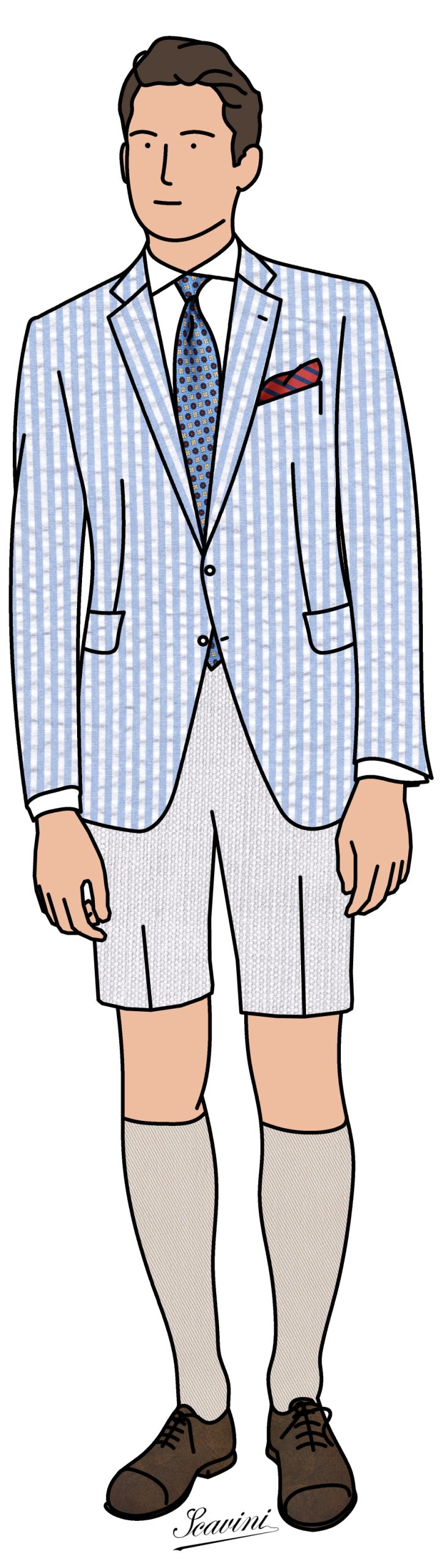
The British, for their part, claim a different origin. Military men stationed in Bermuda — then home to the Royal Navy’s North Atlantic command — are said to have requested shorter trousers, finding the standard issue ill-suited to tropical climates. Admiral Mason Berridge gave his approval, on one condition: that these new trousers be worn with long socks. A nostalgic nod, perhaps, to the days of breeches and silk stockings.
The resulting military Bermuda short came pleated, could be worn day or night, and grew so popular that locals adopted it into their national dress — proudly worn by the island’s police force.
A matter of centimetres
So then, what is the right length? Josh Sims mentions 7.5 cm above the knee. The English-language version of Wikipedia is more restrained, suggesting 2.5 cm. In all cases, it’s above. The French Navy, for its part, makes no concessions: their Bermuda shorts rise boldly up the thigh — 10 to 15 cm above the knee. It takes trained (and ideally tanned) legs to wear them with flair.
One useful rule of thumb: the longer the Bermuda, the wider the cut should be. A slim fit that’s too long locks the knee when seated. That’s why surf-style Bermudas are wide — they fall low, but stay comfortable. Conversely, a shorter cut can afford a trimmer silhouette. As for the finishing touches, it’s up to personal taste: a plain hem or a neat cuffed edge.